

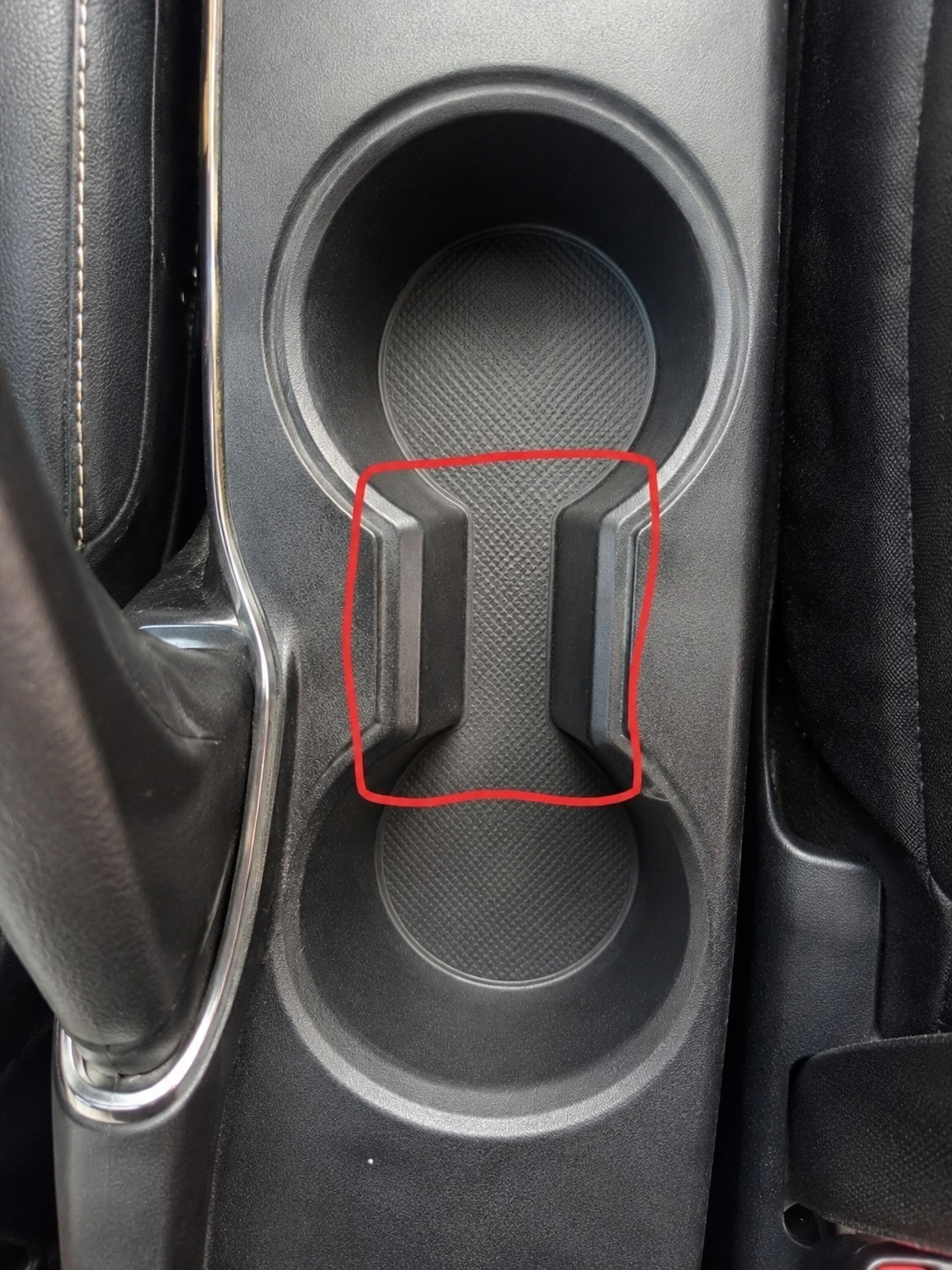
Why Is the Gap Shaped Like That?
If you look closely at your console, the gap isn’t just a random hole; it is highly optimized. Automotive designers specifically shape this channel to solve several real-world problems simultaneously:
Dual-Mug Compatibility: The center slot allows you and your front-seat passenger to store handled mugs side-by-side. By orienting the handles inward toward the center gap, both large cups can sit completely flat and flush against the bottom of the console.
The “French Fry” Secondary Utility: While the handle is the primary design reason, engineers are well aware of “secondary use cases.” The bridge area is structurally reinforced because it naturally becomes a catch-all for loose change, car keys, hair ties, or yes, even fast-food dipping sauce containers.
Structural Integrity and Cleaning: Molded plastic needs to withstand years of pressure, heat variations, and vertical force. Linking the two cup holders with a center channel actually makes the plastic piece more resilient to snapping than if they were completely independent, deep pockets separated by a razor-thin wall. Furthermore, it makes the console much easier to wipe down and clean.
A Short History of the In-Car Drink
To truly appreciate this tiny detail, it helps to realize how long it took automakers to take our beverages seriously.
In the 1950s and 60s, drive-in theaters and roadside diners prompted the invention of plastic trays that hooked over rolled-down window glass. When built-in “cup holders” finally debuted in the 1980s, they were often nothing more than shallow, useless dimples stamped into the inside of a glove compartment door—completely useless while the vehicle was in motion.
It wasn’t until the late 1990s and early 2000s, driven fiercely by the commuter culture in North America and the rise of massive premium coffee chains, that interior design teams began employing dedicated ergonomic engineers just to study how we drink while driving. The center gap is a modern product of that exact evolution.
So, the next time you slide your morning travel mug into the console and it settles perfectly into place with a satisfying, stable click, you can thank the anonymous automotive engineers who looked at two simple circles and decided to bridge the gap.